Car keys · Burlington
Transponder Key Programming
The new key slides into the ignition and turns exactly the way the old one did, but the engine only cranks. A dashboard light blinks near the fuel gauge, and no amount of turning the key gets the car past that cranking sound.
Transponder Key Programming
In plain words
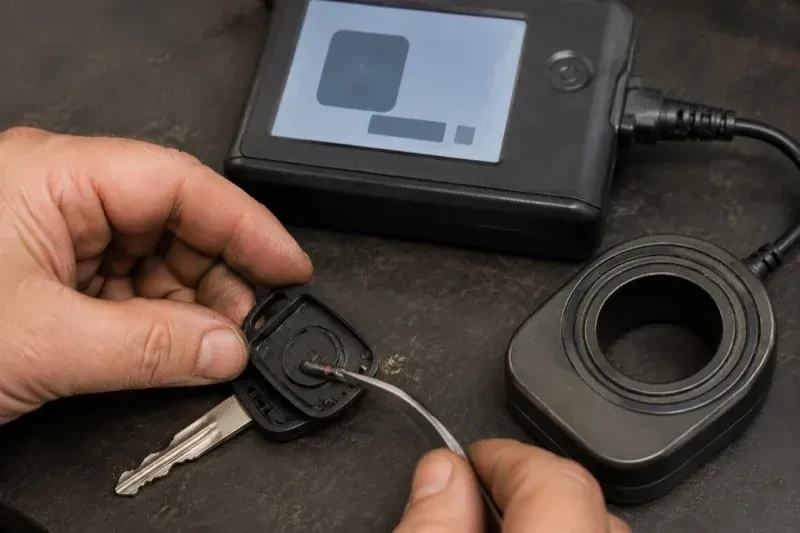
There are really two separate keys hiding inside one piece of metal and plastic: the cut, which is entirely mechanical and opens doors and turns cylinders, and the code, which is electronic and tells the immobilizer to allow the engine to run. A key can be perfectly cut and still leave a car cranking without starting if the code was never written. Programming is the part of the job that handles the code, using equipment built to read and write the exact system fitted to that vehicle.
How the visit goesThe blade snapped off flush with the door lock last winter, and the shop that cut a replacement only matched the metal shape. The fob still locks and unlocks the doors from across the driveway, but the engine cranks over and over without ever catching.
Burlington
How the visit goes
Reading the vehicle's own system
Every vehicle answers a question the locksmith asks before touching a key: what generation of chip does this immobilizer expect, and where can its key list be reached? A simple fixed-code chip behaves differently from a rolling-code or encrypted one, and some models allow a key to be added through the onboard diagnostic port while others gate that list behind a manufacturer-level security session. Reading this correctly first avoids wasted effort later and tells the locksmith exactly which chip family the new blank needs to carry.
Cutting the blade first
The mechanical side of the job comes first and is the more familiar half of it: the blade is cut to the lock's own pattern, either from a code on file or by duplicating a working key, and fitted into a blank carrying the correct chip. A perfectly cut blade still will not start a vehicle with an immobilizer on its own, which is the detail that catches out a counter kiosk. The two halves of the key are treated as separate tasks throughout, cut first, chip second.
Looking after the fob
A fob that has just been given a fresh battery and paired functions should be treated normally rather than babied, but a couple of habits extend its working life: avoid leaving it somewhere that gets very hot, such as a dashboard in direct sun, and replace the battery again at the first sign of a weak or intermittent response rather than waiting for it to fail outright. The metal emergency insert is worth testing once, so its location and its awkwardness are familiar before it is actually needed.
Transponder Key Programming
In the van
- Security-access module
- Emergency insert blade
- Chipped key blank
- Bench programming adapter
- VIN reference tool
What affects the quote
Same fees day, night or weekend
1Cutting method: by code or by duplication
Cutting from a manufacturer code tends to be more direct than duplicating from a worn or damaged working key, where extra care is needed to read the original cuts accurately before a blank is shaped to match.
2Trim or dash removal some models need for access
A small number of vehicles place the antenna ring or module somewhere that needs a panel or trim piece moved for a clear connection, which adds a step beyond the programming itself on those specific models.
3Fob battery or housing replacement
A fob with a failing battery, cracked buttons, or a worn housing may need that hardware replaced alongside the programming, which is identified during the initial check of the key rather than assumed either way.
Transponder Key Programming: questions
Does the fob need a new battery every time a key is programmed?
Not necessarily, but it is checked every time regardless. A battery that is already weak is often easier to replace during the same visit than to leave for another call later, and a marginal battery can make a freshly programmed fob look like it has a fault when the chip itself is working exactly as intended.
Can a push-button, proximity-style key be programmed the same way?
Yes, though there is usually more to pair afterward: the proximity functions that let the vehicle detect the key nearby, alongside the same immobilizer identity a traditional transponder key would carry. The visit still ends with the same test, confirming the engine starts and the vehicle recognizes the key at a normal walking distance.
How does a lost or stolen key get made useless?
Its identity is deleted from the immobilizer's memory during the same visit that adds the replacement, using the same connection to the vehicle's module. Once cleared, that key still opens a mechanical lock it happens to fit, but it no longer authorizes the engine, which removes the part of the vehicle that actually matters to whoever might be holding it.
Car Keys
- Car Key ReplacementYou bought the car privately and it came with a single key on a shoelace.
- Spare Car Key DuplicationA car sits at the cottage all season, and the only key to it lives on a ring three hours away in…
- Key Fob ProgrammingThe remote clicks the way it always has, but the vehicle no longer locks, unlocks or answers with…
Transponder Key Programming near you
The lock services offered in Burlington are grouped the way a door is used. Getting back in when you are locked out. Deciding who holds a working key. Upgrading the hardware so the door resists more than a casual try. Keeping commercial entrances working. Opening and maintaining safes. Each is described below.